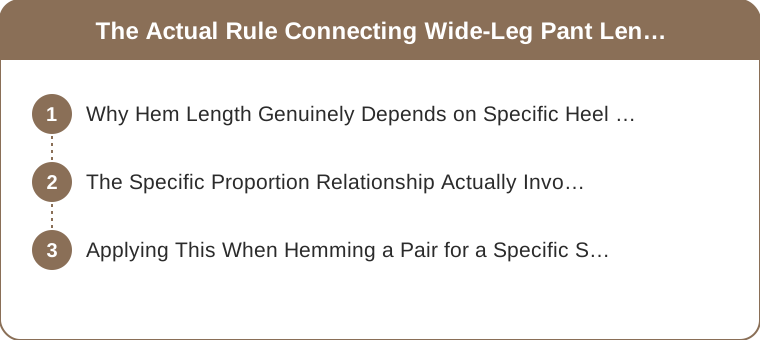
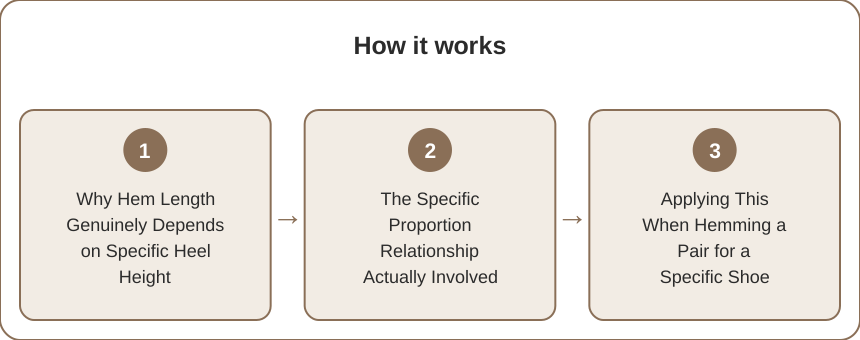
The Actual Rule Connecting Wide-Leg Pant Length to Shoe Heel Height
Quick Answer: Hem your wide-leg pants for the heel height you’ll actually wear them with most. Every extra inch of heel needs roughly an inch less hem to keep the same floor-grazing line. A pair hemmed perfectly for flats will drag with a 3-inch heel — and a pair hemmed for heels will hover awkwardly above your ankle in sneakers.
You bought the wide-legs. The tailor asked “how short?” You guessed. Now they puddle with your loafers and flood with your boots, and you’ve quietly stopped wearing them.
That’s not a fit problem. It’s a math problem, and nobody told you the formula.

Why Does Wide-Leg Pant Length Depend on Heel Height?
Because heel height physically lifts your ankle off the ground, and the hem has to travel that same distance.
Wide-leg pants are meant to break at or just above the floor — usually a 1/4 to 1/2 inch of clearance so the hem skims without sweeping. That clearance is measured from the floor, not from your ankle. So the moment you change what’s under your foot, you change the measurement.
Put a 3-inch heel under a hem cut for flats and you’ve just added 3 inches of fabric that has nowhere to go. It drags, it frays, it kills the clean vertical line the wide leg exists to create.
Straight legs and skinny legs forgive this. A narrow hem can stack or crumple at the ankle and read as intentional. A wide hem can’t — there’s too much fabric, and it goes from column to curtain.

What’s the Actual Rule? (The Inch-for-Inch Formula)
One inch of heel = roughly one inch of hem. It’s close to linear, and that’s what makes it usable.
Run the numbers on a pair hemmed for a 3-inch heel:
- Worn with 3-inch heels: perfect, skims the floor
- Worn with 1-inch flats: hem sits about 2 inches high — reads cropped-by-accident
- Worn with 4-inch heels: hem drags about 1 inch — reads too long
Two inches sounds like nothing. On a wide hem it’s the difference between “tailored” and “borrowed from someone taller.”
One caveat: it’s roughly linear, not exactly. Very high heels (4 inches and up) tilt your foot forward and shift your whole posture slightly, so you may need a hair less than the raw inch-for-inch number. Try before you commit.
Myth vs Fact
Myth: “Just hem them to the middle — they’ll work with everything.” Fact: The middle works with nothing. A hem split between a flat and a 3-inch heel is an inch too long for one and an inch too short for the other. Compromise hems look accidental in both directions.
Myth: “Wide-leg pants should always touch the floor.” Fact: They should nearly touch — 1/4 to 1/2 inch of clearance. Actual contact means you’re walking on your hem, and the back edge will be shredded within a season.
Myth: “A tailor can just eyeball it.” Fact: A tailor can only measure what you’re standing in. Show up in the wrong shoes and you’ll get a technically perfect hem for shoes you don’t own.
Myth: “Cuffing fixes a too-long hem.” Fact: Cuffing works on denim and straight legs. On a wide leg it creates a heavy horizontal band at the widest point of the pant, which visually chops your leg exactly where you don’t want it chopped.
How Do You Hem Wide-Leg Pants for a Specific Shoe?
Bring the actual shoes. Not similar shoes. Not “these are about the same height.” The specific pair.
The full protocol:
- Pick your dominant shoe — the one you’d wear with these pants 70% of the time. That’s what you hem for.
- Wear it to the fitting, and wear the underwear or shapewear you’d normally wear too, since rise placement shifts the whole length.
- Stand naturally. Don’t lock your knees or lift your chin — that’s not how you stand at a bus stop.
- Check the back. Wide-leg hems often sit lower at the back than the front. The back edge is what drags.
- Walk five steps before the pins come out. A hem that looks right standing still can sweep the floor in motion.
If you genuinely split your wear between flats and heels, you have two honest options. Hem for the flat (the shorter cut) and accept that heels make them slightly cropped — which currently reads as deliberate. Or buy the pants twice in your two favorite washes and hem each pair to a different height. Tailoring costs $15–25 a pair; a second pair of pants costs more but solves it permanently.
FAQ
Should wide-leg pants touch the floor?
Nearly, but not quite. Aim for 1/4 to 1/2 inch of clearance with the shoes you’ll wear most. Full contact means the back hem drags, and dragging destroys the edge fast.
How much shorter should I hem for flats vs heels?
Subtract the heel height difference, roughly inch for inch. Going from a 3-inch heel to a 1-inch flat means taking about 2 inches off. Pin it, walk in it, then cut.
Can one pair of wide-leg pants work with both sneakers and heels?
Not perfectly. If you need one pair to stretch across both, hem for the sneaker and treat the heeled version as an intentionally cropped look — that direction reads modern, while the reverse just reads too long.
TL;DR
- Hem length is measured from the floor, so heel height changes the requirement inch for inch.
- Hem for the shoe you’ll wear 70% of the time, not an average.
- Target 1/4 to 1/2 inch of clearance, checked standing and walking.
- Bring the actual shoes to the tailor — “about the same height” isn’t.
- Too short reads intentional; too long reads borrowed. When in doubt, go shorter.
A high waist drawstring wide leg pant makes this easier than denim does, by the way — the drawstring rise lets you set where the waist sits, which is the other half of the length equation.
See It in Motion
Seen here: High Waist Drawstring Wide Leg Yoga Pants with Pockets — shop it on bubblelime.com
Keep Reading
This article is for general styling and informational purposes only. Trends, sizing, availability and pricing may vary by brand and season.